

Busy season has a way of exposing every weakness in your IT environment. Systems that feel “mostly fine” in the fall can quickly become bottlenecks once deadlines compress, hours extend and tolerance for disruption disappears.
According to a recent report from Thomson Reuters, CPA firms continue to face intense capacity pressure driven by staffing shortages, rising client expectations and tighter timelines. During busy season, that pressure magnifies the impact of even small IT issues.
The goal heading into busy season is not innovation; it’s predictability. And predictability starts with addressing known risks before they become crisis points.
Here are five IT priorities CPA firms should lock down now, before workloads spike and the margin for error disappears.
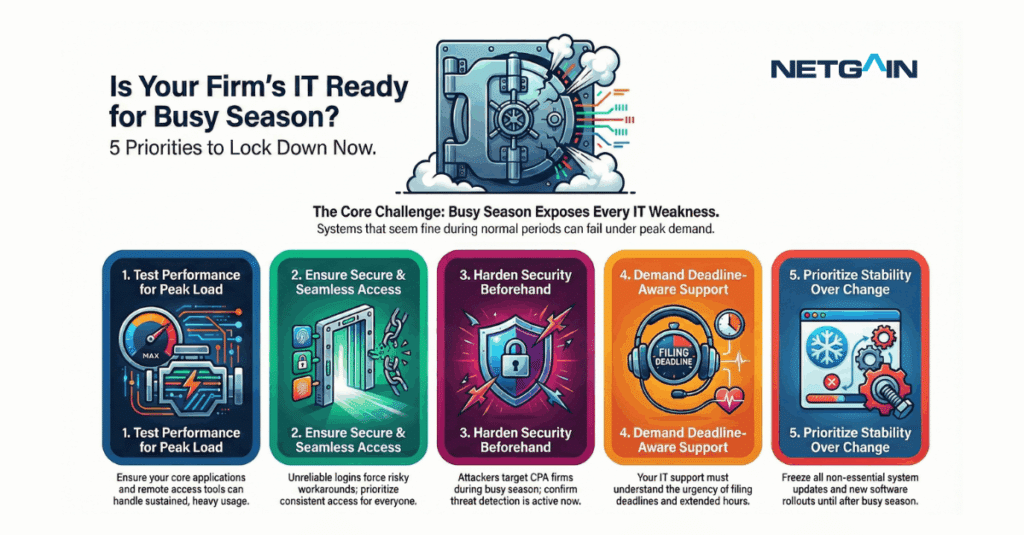
1. Performance and reliability under peak load
If systems slow down, everything slows down.
Busy season puts sustained pressure on core applications, virtual desktops and remote access tools. Many firms discover too late that their environment was built for average usage, not peak demand. When your tax software freezes at 9 p.m. on April 14th, that’s not just an IT inconvenience; it’s a firmwide problem that puts client deliverables at risk.
Recent research from Gartner continues to show that even short periods of IT disruption can have an outsized impact on productivity in professional services firms, where work is deadline-driven and highly dependent on system availability.
Before busy season starts, firms should:
- Validate infrastructure can handle extended hours and heavier usage
- Confirm performance is consistent for in-office and remote staff
- Identify and resolve known bottlenecks before they become firmwide problems
For a deeper look at why many firms reassess their IT approach ahead of peak workloads, this blog on rethinking IT before busy season offers helpful context.
2. Secure, seamless access for every user
Busy season means more logins, more devices and less patience for workarounds.
Staff need fast, reliable access to applications and data without sacrificing security. When access is unreliable or overly complex, people find shortcuts, which introduces risk at exactly the wrong time. Predictable access keeps teams productive and security intact.
Microsoft’s recent Digital Defense Report highlights identity-based attacks as the leading entry point for breaches, particularly in environments with widespread remote access and extended work hours.
Before busy season, firms should ensure:
- Identity and access controls are working as intended
- Remote access performs consistently regardless of location
- New or temporary staff can be onboarded quickly and securely
If access challenges tend to surface every tax season, this post on IT planning considerations as firms head into tax season outlines where those cracks usually form.
3. Lock down security before attackers do
Busy season is prime time for cyber threats. Attackers know CPA firms are handling large volumes of sensitive data under tight deadlines and stretched resources.
A recent FBI Internet Crime Report shows that ransomware and phishing remain among the most prevalent and costly cyber threats, with professional services firms continuing to be frequent targets.
Busy season is not the moment to get serious about security. That work should already be completed before it starts.
Firms heading into busy season should confirm:
- Threat detection and response tools are actively monitored
- Incident response processes are defined and tested
- Staff are not forced to make judgment calls under pressure about suspicious activity
For firms looking to reduce risk without slowing teams down, check out some practical guidance on technology and security considerations for a smoother busy season.
4. IT support that knows the difference between March and July
During busy season, response time matters more than ever.
IT support teams must understand CPA firm workflows, deadlines and the real business impact of downtime. A delayed response at the wrong moment can derail an entire team’s day. Generic MSP support doesn’t cut it when every hour counts toward a filing deadline.
As Accounting Today has consistently noted in its tax season coverage, compressed timelines leave firms with little margin for operational disruption, making responsive and knowledgeable IT support critical.
Before busy season, firms should confirm:
- Support coverage aligns with extended busy-season hours
- Escalation paths are clear for time-sensitive issues
- Communication expectations are defined before problems arise
Support during busy season should prioritize business impact, not ticket volume. That means your IT partner needs to understand what April 15th actually means for your firm.
5. Stability before change
Busy season is not the time to experiment.
Major system changes, migrations or new tools introduce risk when teams can least afford it. Stability should take priority until workloads normalize. Predictable systems reduce stress, errors and rework when pressure is highest.
That includes:
- Completing updates and maintenance ahead of busy season
- Freezing non-essential changes to core systems
- Setting clear guardrails around tools like AI so usage supports work instead of distracting from it. When the pressure’s on, stable systems help your team stay focused and avoid costly errors.
Busy season rewards preparation
CPA firms do not need perfect IT environments to survive busy season. They need reliable and predictable ones.
Firms that lock down performance, access, security, support and stability before workloads spike spend less time reacting and more time serving clients. Laying that foundation ahead of busy season not only makes busy season more manageable, but it also positions firms to make smarter technology decisions once the pressure lifts.
If you want a second set of eyes on whether your IT environment is truly busy-season ready, Netgain works with CPA firms to identify risks, reduce friction and build stability before peak demand hits. You can learn more about our approach or start a conversation here.