

Once AI is in use, even in limited ways, the conversation shifts quickly.
It is no longer about whether AI can help. It is about how easily it can create risk when pressure is high and boundaries are unclear.
Busy season is when small lapses turn into firmwide problems. That is especially true with AI, where well intentioned shortcuts can introduce security, compliance and client trust issues long before anyone realizes what happened.
Understanding where AI helps is important. Understanding how it goes wrong is just as critical.
Three AI mistakes we’re seeing this busy season
These issues are not theoretical. They are already surfacing across CPA firms navigating AI use under deadline pressure.
- The late-night shortcut. A senior associate pastes client Schedule K-1 data into ChatGPT free tier at 11 p.m. to “quickly summarize.” The problem: that data now lives on OpenAI’s servers and could be used for model training. Free versions of AI tools do not include the data privacy safeguards that paid versions provide.
- The fabricated citation. A staff accountant uses AI to draft a technical memo on partnership basis calculations. The AI invents a Revenue Ruling that doesn’t exist. The memo goes to the client before anyone catches it. This is a real risk that several CPA firms have already encountered.
- The access creep. Remote staff use AI to “help remember” client portal passwords or organize login credentials. This creates an identity management and security nightmare that IT discovers in April, when there’s no time to fix it properly.
These mistakes share a common root cause. AI use outpaces policy and oversight.
Microsoft’s recent Digital Defense Report reinforces that identity-based attacks and data exposure remain leading threats, especially in environments with extended hours and widespread remote access. Without clear boundaries, even well-intentioned AI use can create unnecessary exposure.
Why guardrails matter more than tools
Most AI problems during busy season are not caused by bad intent or reckless behavior. They stem from ambiguity.
Staff are trying to move faster. Partners want progress without surprises. IT is expected to manage risk without slowing teams down.
Without clear guardrails, everyone fills in the gaps differently.
Effective guardrails do not require lengthy policy documents or complex approvals. They require clarity that holds up under pressure.
At a minimum, firms should be able to answer:
- Which AI tools are approved for use during busy season
- What types of data are allowed and prohibited
- Where AI can support work and where it cannot
- Who owns enforcement and escalation when boundaries are crossed
When these questions are unanswered, AI use becomes inconsistent and difficult to control.
The risk-based framework that works
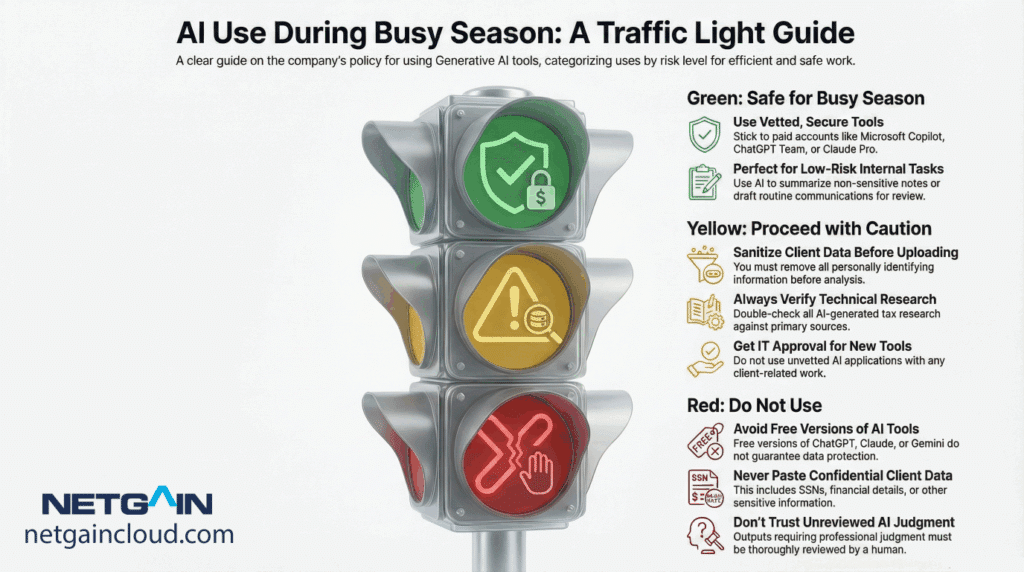
During busy season, staff need rules they can remember and apply quickly. Long policy documents do not help at 10 p.m. on a deadline night.
A simple traffic light framework is far more effective.
Green: Safe for busy season
These uses are bounded and verifiable:
- Microsoft Copilot within your M365 environment (data stays in your tenant)
- ChatGPT Team or Claude Pro with paid accounts (contractual data protection included)
- Summarizing non-sensitive internal documents or meeting notes
- Drafting routine client communications that will be reviewed
Yellow: Proceed with caution
These require extra steps:
- Uploading client data for analysis (sanitize first, remove identifying information)
- Using AI for technical tax research (always verify outputs against primary sources)
- New tools not yet vetted by IT (get approval before using with any client work)
Red: Do not use during busy season
These introduce unacceptable risk:
- Free versions of ChatGPT, Claude or Gemini (data protection not guaranteed)
- Pasting client SSNs, financial details or confidential data into any AI tool
- AI outputs that require professional judgment without thorough review
- Experimenting with untested tools when deadlines are tight
The difference between paid and free AI tools matters significantly during busy season. Tools like ChatGPT Team, Claude Pro and Microsoft Copilot for M365 include data privacy safeguards that prevent your inputs from being used to train their models. Free versions do not. This distinction isn’t about features. It’s about client data protection.
Ownership matters as much as rules
Guardrails only work when ownership is clear.
IT typically owns tool approval, access controls and monitoring. Firm leadership owns risk tolerance, client expectations and accountability. Staff need guidance they can trust and follow consistently.
When ownership is unclear, enforcement becomes reactive. Issues surface late, often during the most stressful weeks of the season.
Aligning on guardrails before deadlines peak gives everyone a shared understanding of what is acceptable and what is not.
Busy season is not the time to experiment
AI experimentation requires space, attention and tolerance for missteps. Busy season offers none of those.
That does not mean firms should avoid AI entirely. It means experimentation should pause in favor of controlled, well-understood use.
Firms that separate experimentation from execution are better positioned to protect clients, support staff and avoid technology-related disruptions when pressure is highest.
Setting up the next step: timing and execution
Guardrails define what is allowed. Timing determines when decisions should be made.
Many AI issues during busy season are not caused by poor intent or weak controls. They stem from decisions being made too late, when there is no time to evaluate tools, train staff or course-correct.
Understanding when to define boundaries, when to pause experimentation and when to observe behavior is just as important as defining the rules themselves.
We will explore that next by outlining a practical AI timeline for busy season that CPA firms can actually follow, from pre-season preparation through post-season review.
Busy season rewards containment, not transformation
CPA firms do not need AI to survive busy season. They need stability, clarity and fewer distractions.
Firms that use AI thoughtfully during busy season focus on defined boundaries, realistic expectations and shared ownership. That approach protects clients, supports staff and gives firm leadership confidence that technology is not introducing new risk at the worst possible time.
For firms looking to reduce risk without slowing teams down, Netgain has also shared practical guidance on technology and security considerations for a smoother busy season.
If you want a second set of eyes on where AI guardrails make sense for your firm and how they fit into broader busy season readiness, Netgain works with CPA firms to help clarify expectations and reduce shadow usage risk. You can start a conversation here.