
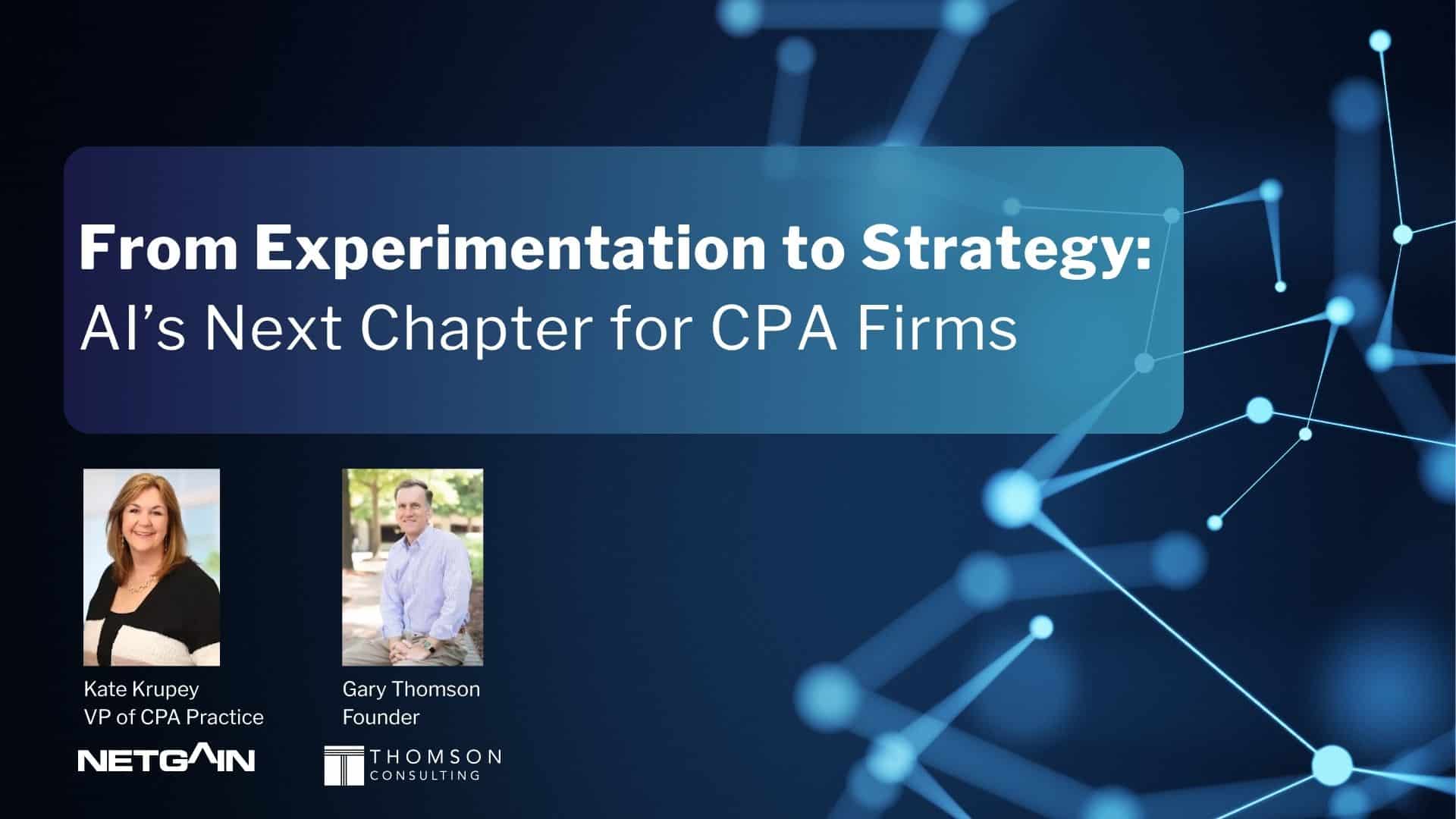
AI is becoming part of everyday decision-making inside CPA firms, not because firms are chasing trends, but because the pressure is getting harder to ignore. Clients are asking different questions. Staff expectations are changing. Leadership teams are trying to sort out what belongs in experimentation, what needs oversight and what can no longer be treated as someone else’s problem.
To talk through what that looks like in practice, we sat down with Gary Thomson, founder of Thomson Consulting and a longtime advisor to managing partners across the country, and Kate Krupey, VP of CPA Practice at Netgain and a former firm CIO.
Gary works closely with firms on strategy, governance and long-term positioning, while Kate brings a more operational perspective rooted in how these decisions affect day-to-day work inside firms. What they see is not a lack of interest. It is a lack of clarity about what comes after the initial excitement.
“AI has become a distinctive part of the conversation,” Gary said. “It’s changing how firms think about everything from operations to client service.”
“Firms are getting into AI quickly,” Kate noted. “What they’re struggling with is what comes next and how to make it consistent across the firm.”
Clients are paying attention
Not long ago, AI mostly lived in pilots, one-off experiments or vendor demos. That is changing. More firms are realizing that AI is starting to influence how they are perceived by clients and prospects, not just how they operate internally.
“There are clear signals in the market,” Gary said. “Organizations are paying attention to which firms are investing in technology and which are not.”
That shift is already creating pressure. Firms that are not making progress in how they use technology are starting to feel it in both operations and positioning, as broader trends across the profession continue to point toward increased investment in growth and technology-enabled services.
This is not really a story about tools. It is a story about confidence, consistency and whether a firm can show that it has a deliberate way of working.
“Clients are looking at this,” Gary added. “It’s becoming part of how they choose who they work with.”
Moving slowly has a cost
Most firm leaders are not dismissing AI. If anything, the hesitation comes from knowing the stakes are real. In a profession built around judgment, risk and accuracy, caution makes sense. But caution has a downside when it turns into drift.
Gary sees that tradeoff clearly.
“If you’re not doing the hard things, like investing in AI, you’re going to feel it over time,” he said.
For firms that value independence and control, this is an uncomfortable spot. They do not want to move recklessly, but they also cannot assume the market will wait for them to get comfortable. The bigger risk for many firms is not that they will move too fast. It is that they will keep delaying decisions while expectations keep changing around them.
The firms making progress are not pretending to have it all figured out. They are testing, learning and tightening their approach as they go.
The real challenge is operational, not theoretical
One of the more useful points Gary raised is that AI gets framed as a technology conversation when it is really a firmwide operating question.
“This is not just about tools,” he said. “It’s about how firms operate, how they think and how they serve clients.”
That creates a more serious set of leadership questions:
- Who owns AI strategy inside the firm?
- How are decisions evaluated and prioritized?
- What does governance look like in practice?
- How is success defined and measured?
Firms that work through those questions early are usually in a better position to move with confidence, because they are not trying to add AI on top of loose processes and vague ownership.
“Governance doesn’t need to be complicated, but it does need to be clear,” Kate explained. “If people don’t know what tools are approved or how to use them, they’ll either avoid AI entirely or use it in ways that create risk.”
For firms looking to put structure around this, having a clear starting point for policies, ownership and decision frameworks can make the difference between stalled experimentation and real progress. This free guide can help you get started.
Where the early gains are showing up
The effects of AI inside firms are often less dramatic than people expect. In many cases, the value shows up in smaller, repeatable improvements that make daily work less manual and less fragmented.
- Client service: Faster analysis and clearer takeaways from large amounts of information
- Talent: Rising expectations from staff who want tools that reduce unnecessary drag
- Operations: Fewer manual steps across tax, audit and internal workflows
- Growth strategy: A stronger ability to deliver work and insight consistently
In other words, the early value is often practical before it is flashy.
“AI is redefining aspects of the profession,” Gary said. “And it’s happening faster than many firms expected.”
“A lot of the early impact is happening in small ways. It’s not always big transformation. It’s saving time on things people do every day, which adds up quickly,” Kate said.
That might mean summarizing client meetings, drafting internal documentation or cutting down the time spent on first-pass analysis. None of those changes sounds dramatic on its own. Together, they start to change how work moves through the firm.
Experimentation still matters, but so does discipline
Gary does not make the case for broad, unfocused AI initiatives, and that is part of what makes his perspective useful. The firms seeing progress tend to start with a few practical use cases and build from there.
“There’s a balance,” he said. “You need to explore, but you also need to be thoughtful about where you invest.”
That usually starts with a small number of use cases tied to real workflows. From there, firms can build internal knowledge, identify where friction is being removed and decide what deserves more investment.
The point is not to get everything right on the first try. The point is to learn fast enough to make better decisions next.
“You don’t need a perfect plan to get started. You need a safe way to test, learn and build from there,” Kate said.
What separates firms that move forward
Looking ahead, Gary sees a gap forming between firms that are treating AI as part of leadership strategy and firms that are still treating it as a side topic.
Firms in the first group will keep adjusting and getting better. Firms in the second group will find that the challenge is no longer just technology. It is that their people, processes and client expectations start drifting out of sync with the market.
“The profession has been through major shifts before,” he said. “This is another one, but it’s moving quickly.”
That is really the heart of it. AI is not a future issue for CPA firms. It is already part of how firms work, how they are judged and how leaders need to think about what comes next.
The firms that handle it best are unlikely to be the loudest. They will be the ones that put structure around it early, learn where it helps and stay clear-eyed about where judgment still matters most.
Want to go deeper?
You can watch the full on-demand conversation with Gary Thomson and Kate Krupey for more perspective on where firms are getting stuck, what good governance looks like in practice and how leaders can take more deliberate next steps.