
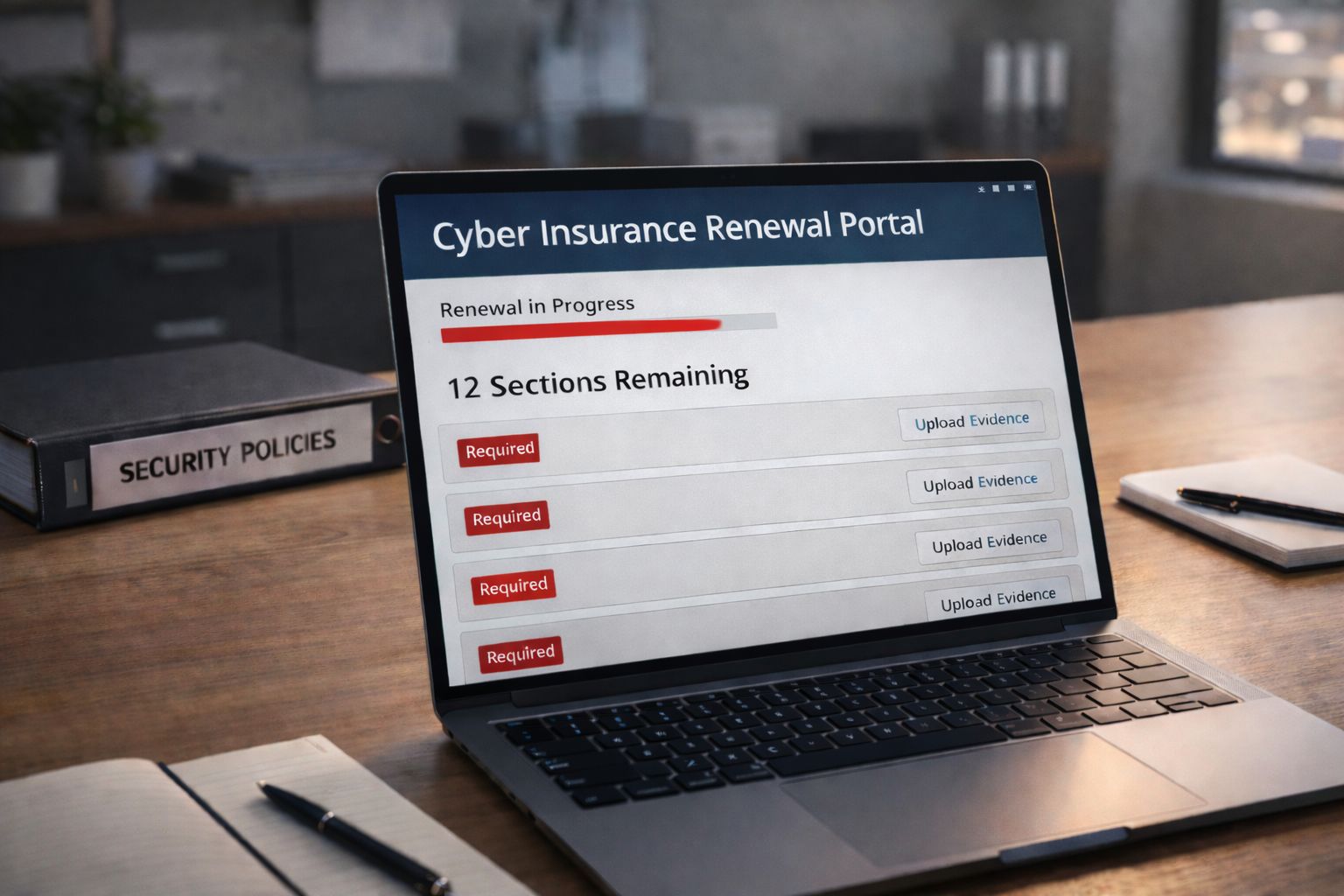
Cyber insurance used to feel like paperwork. In 2026, it feels more like an audit.
Renewal applications are longer. Questions are more technical. Underwriters increasingly want evidence, not just yes or no answers. For CPA firms, that shift creates real pressure. The same IT leader managing infrastructure and tax-season support is now expected to produce enterprise-grade security documentation.
The requirements are not mysterious. The challenge is operationalizing them in a way that works during busy season, not just on renewal day.
Identity and Access Controls Are Non-Negotiable
Identity is where underwriting scrutiny now begins.
Expect detailed questions about multi-factor authentication across all access, whether it is through workstations, mobile devices, local or remote, targeting your line of business applications or business email and communication services. Expect follow-up questions about privileged and administrative access, onboarding and offboarding procedures, and how seasonal or offshore staff are managed.
This focus mirrors broader federal guidance that emphasizes strong identity management, MFA and least-privilege access as foundational controls.
For CPA firms, this is not theoretical. Tax season hiring and distributed teams increase complexity. A single missed deprovisioned account can create real exposure.
Saying “we use MFA” is no longer enough. Underwriters increasingly want to understand where it is enforced, how privileged accounts are protected and whether access changes are consistently documented and monitored.
Firms already feeling operational strain from growing IT complexity tend to see this most clearly. Identity management is not just a security control. It is an operational discipline that has to scale.
24×7 Detection and Response Is the New Baseline
Basic antivirus no longer satisfies underwriting scrutiny.
Applications now commonly ask whether Endpoint Detection and Response (EDR) is in place, whether it is monitored continuously and who is responsible for investigating alerts.
Recent industry reporting continues to show that organizations without active monitoring experience significantly longer attacker dwell times. The longer a threat goes undetected, the more expensive the outcome.
Breach data also continues to reinforce that credential abuse and ransomware remain dominant attack patterns.
For CPA firms, this creates a practical gap. Underwriters expect continuous monitoring and documented response capability. Many firms operate with lean IT teams that cannot realistically provide round-the-clock oversight on their own.
If your detection model depends on someone checking alerts during business hours, that is increasingly viewed as a weakness.
The real shift is from “we have tools” to “we have continuous monitoring and documented response.” That visibility, and the reporting behind it, is what makes underwriting conversations smoother. Firms that formalize this into a structured, always-on security model tend to find underwriting conversations far more predictable.
Backup and Recovery Must Be Provable
Ransomware has permanently changed how insurers evaluate backup strategies.
It is no longer sufficient to say, “We back up to the cloud.” Underwriters want to know whether backups are segmented or immutable, how often restores are tested and how long full recovery would take.
Industry data continues to show ransomware as one of the most disruptive breach patterns across sectors.
For CPA firms, downtime during peak season can be as damaging as data loss. Recovery time objectives matter. Restore tests matter. Documentation matters.
Being able to demonstrate tested recovery procedures strengthens both operational resilience and underwriting outcomes. It also reduces the last-minute scramble when renewal questions start landing in your inbox.
Governance and Documentation Are Under the Microscope
Technical controls are only part of the equation. Governance maturity matters.
Underwriters are evaluating whether your firm has:
- Written information security policies (WISP)
- Formal risk assessments
- A documented incident response plan
- Ongoing security oversight
- Alignment with applicable regulatory frameworks
CPA firms operate under specific expectations. The FTC Safeguards Rule requires a written information security program and ongoing risk assessment.
IRS Publication 4557 provides guidance tailored specifically to tax professionals and emphasizes documented security practices.
Underwriters increasingly expect firms to demonstrate alignment with these frameworks. Governance documentation is not busywork. It is evidence that security is managed deliberately and consistently. That kind of structure typically requires more than ad hoc IT support. It requires defined controls, reporting and ongoing oversight.
Security maturity and overall IT maturity are closely linked. Firms that take a structured approach to their technology environment tend to find that insurance reviews become more predictable and less disruptive.
Why This Matters for CPA Firms
Underwriters are effectively setting a minimum cybersecurity standard for the profession. The expectation is continuous monitoring, documented controls and structured governance, regardless of firm size.
During tax season, resources are stretched. Expecting a lean IT team to manage infrastructure, support users, respond to incidents and produce detailed renewal documentation at the same time is unrealistic.
More firms are rethinking how IT is structured before busy season hits.
The firms that feel the least pressure at renewal are not the ones who rush to fill out the application. They are the ones who treat cybersecurity as an ongoing operational discipline.
If your renewal is within the next 90 days, now is the time to:
- Validate MFA enforcement across all privileged accounts
- Confirm detection coverage and response ownership
- Review backup testing documentation
- Update your incident response plan
Underwriters are asking harder questions in 2026. Firms that build continuous monitoring, structured documentation and shared accountability into their operating model will be in a much stronger position, both for insurers and for clients.
If your renewal is approaching and you would like to pressure-test your current posture before submitting another application, start with a renewal readiness conversation. A short, focused review now is far easier than answering tough underwriting questions under deadline pressure.