

For many CPA firms, the AI journey starts with good intentions and a credit card. A Copilot license here, a ChatGPT account there, maybe even a firmwide announcement that “we’re using AI now.” And then, not much happens. Usage stays low. Workflows stay the same. Leadership starts asking why the investment has not made a dent in day-to-day work.
This disconnect is becoming increasingly common. Firms know AI matters, but many are learning the hard way that access alone does not drive adoption or results.
Why AI pressure is hitting CPA firms all at once
The urgency around AI is not coming from one direction. Talent shortages continue to strain capacity. Margins remain tight. Clients expect faster turnaround without higher fees. At the same time, a new wave of private equity and venture-backed CPA firm rollups is positioning itself as AI-first, grabbing attention and resetting expectations across the market.
Together, these forces create a widening expectation gap. Firms feel compelled to act quickly, even when the path forward is unclear, because standing still feels riskier than moving fast.
The misconception at the center of most AI efforts
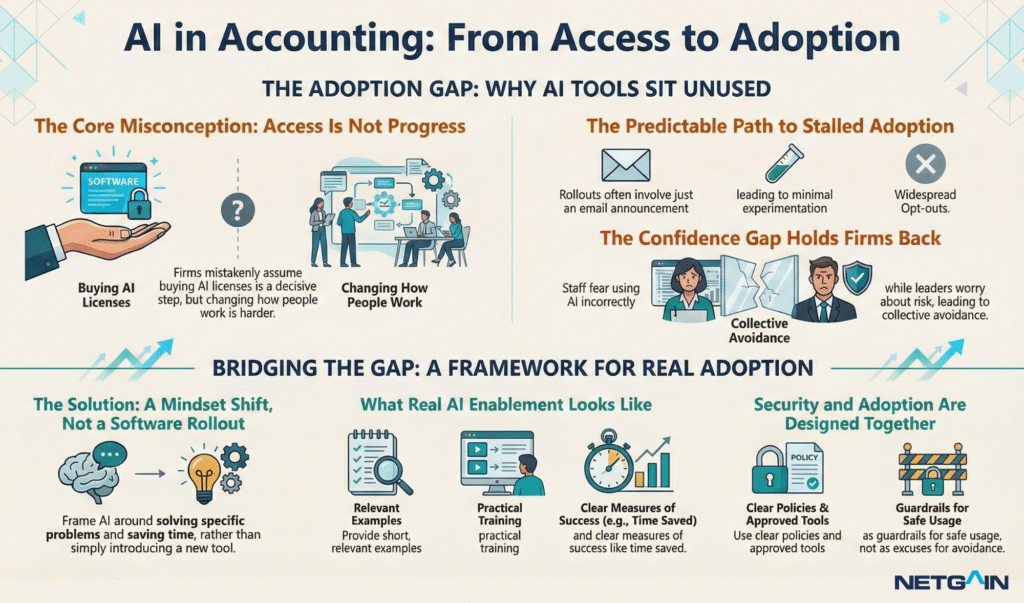
The biggest mistake firms make is assuming that access equals progress. AI tools are easy to turn on. Anyone can sign up for ChatGPT or activate Copilot in minutes. Buying AI feels decisive. Changing how people work does not.
In many firms, AI rollout looks like this:
- Leadership approves licenses
- An internal email announces the tool
- A small group experiments while most staff opt out
The outcome is predictable. Adoption stalls, confidence drops and AI quietly earns a reputation for being “not useful for what we do.”
Why “we tried AI and it didn’t work” usually misses the point
When firms say AI failed, what they usually mean is that no one showed staff how to use it in the context of their actual work. AI gets framed as a way to write better emails or summarize documents, not as a way to support real accounting, tax or advisory workflows.
Staff may test it on a client email, try it once for research or experiment with the wrong model, get weak results and move on. Without guidance, those early misfires become the final verdict. The issue is not that AI does not work. It’s that no one helped people learn how to make it useful.
The confidence gap holding firms back
Underneath low adoption is a confidence problem. Staff worry about using AI incorrectly or exposing sensitive information. Leaders worry about introducing risk in a regulated environment. Neither group wants to be the test case that gets it wrong.
That hesitation is rational. But without clear guidance, guardrails and examples, the default becomes avoidance. And when avoidance sets in, even capable tools sit idle.
Security and compliance are valid concerns, not excuses
In accounting, caution around AI is understandable. Client data, regulatory requirements and professional standards matter. But avoiding AI entirely introduces its own risk, especially as competitors learn how to use it responsibly and efficiently.
Successful firms address this head-on by setting clear policies, approving specific tools and tying AI usage to defined workflows. The risk is not that AI will be used incorrectly. The risk is that it won’t be used at all while others figure it out.
Security and adoption are not opposites. They are designed together.
Reframing AI adoption the right way
AI is not a software rollout. It’s a mindset change.
Adoption sticks when firms focus less on tools and more on outcomes. Instead of asking people to “try this AI,” effective firms frame AI around solving specific problems, saving time or reducing rework in everyday tasks. Role-based examples, practical training and reinforcement over time matter far more than the number of licenses purchased.
What real AI enablement looks like
Firms that see results invest in enablement, not just access. That typically includes:
- Short, relevant examples tied to real CPA firm tasks
- Training that respects how professionals actually work
- Clear measures of success, such as time saved, capacity gained or errors reduced
This approach builds confidence and momentum instead of skepticism. It also gives firm leaders a practical way to evaluate whether AI investments are actually paying off.
The takeaway: adoption is the work
For CPA firms serious about AI, the real challenge is not deciding which tool to buy next. It’s helping their people use what they already have, effectively and responsibly.
That’s exactly where AI enablement matters. Netgain’s AI Enablement Services are designed to help firms move from access to adoption with practical education, clear guardrails and workflows that actually fit how CPA firms work. If you’re ready to make AI useful in day-to-day operations, we have the resources you need.