

When someone proposed a new advisory practice or service line, Gary Thomson learned to ask for more than a good idea. Enthusiasm mattered, and the opportunity might fit the firm’s strategy. But before committing people and money, he wanted a business plan: What would it take, who would lead it and what should the firm expect in return?
“This isn’t rocket science,” said Gary, founder of Thomson Consulting.
Yet firms haven’t consistently brought that same discipline to AI. A partner finds a promising tool, a peer recommends a platform or a vendor introduces a feature, and the firm starts exploring before deciding what it wants to accomplish.
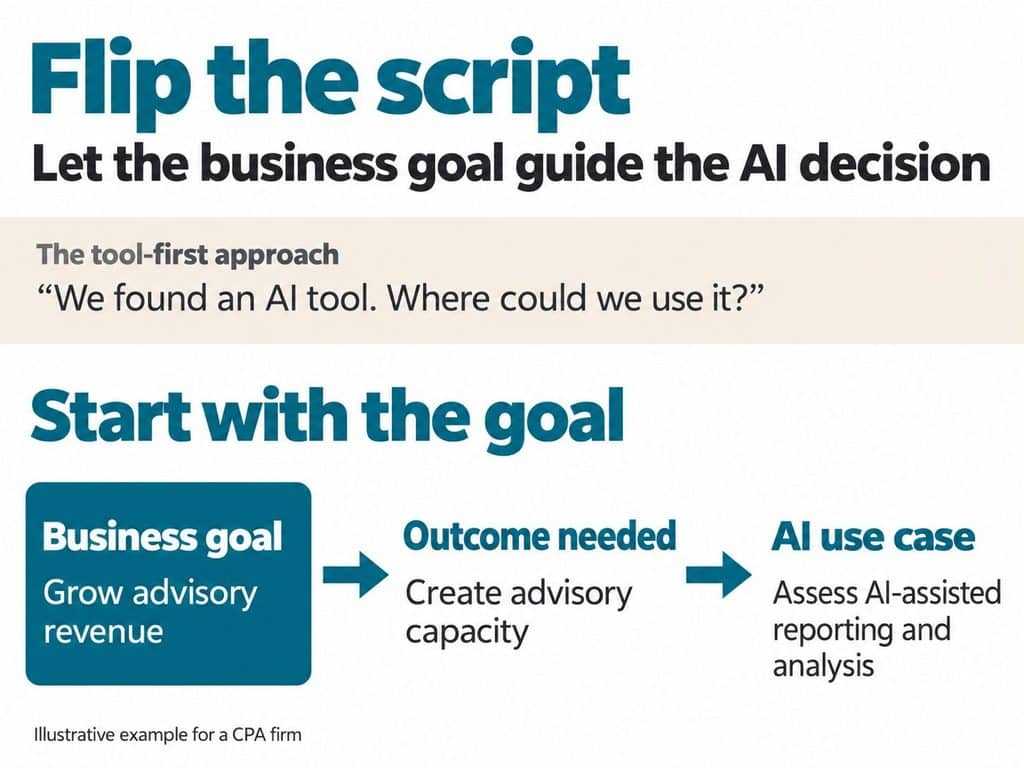
The opportunity is to flip the script. Start with the firm’s business goals, then work backward to where AI could contribute. For Gary and Kate Krupey, Netgain’s VP of CPA Practice, that approach gives leaders a familiar way to evaluate unfamiliar possibilities. It also creates room to experiment, with clearer expectations about the resources involved, what the firm hopes to learn and when to change course.
Start with the priority, then explore the possibilities
Two CPA firms across the street from each other may have different strategies: One wants to grow advisory revenue, while the other wants to improve client service without expanding its team. A tool that deserves investment at one may be a distraction at another.
Peer recommendations and employee ideas can reveal useful opportunities. The next step is connecting them to a priority the partners have already agreed on. If advisory growth is the goal, which part of delivering that work needs to change? Where would additional capacity make a difference?
That clarity can speed decisions. Gary cautions against interpreting business planning as a requirement to deliberate for months before trying anything. People who understand the firm’s priorities can evaluate an unexpected opportunity more quickly because they know what it needs to accomplish.
An AI business case should account for the effort required to put the idea into practice. License costs are only part of it. Implementation, training, governance and ongoing oversight also consume resources.
Gary uses a straightforward example: If an employee needs 200 hours to lead a project, where will those hours come from? Something else must move. Assigning ownership without making time available leaves the project competing with an already full workload.
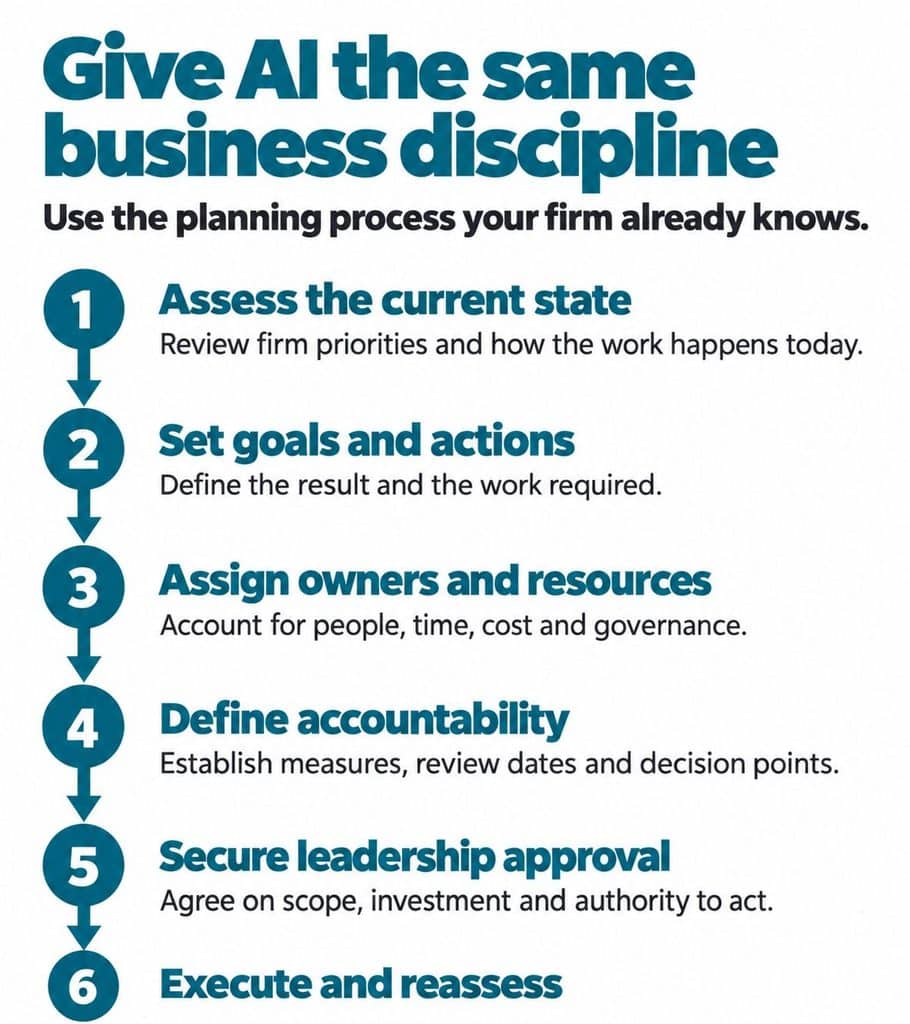
Before approving the investment, establish:
- The current state: How does the work happen today, and where are the delays or manual steps?
- The operating plan: Who owns the result, who contributes and what resources do they need?
- The investment decision: Should the firm buy an existing solution or build something it will need to maintain?
Kate recommends mapping the process before changing it. Seeing how information and work move between people and applications can reveal whether the proposed AI use addresses the actual bottleneck.
Include people’s capacity for change
A promising product can arrive at the wrong time. Employees may already be absorbing a new application, revised procedures or an acquisition. Adding another initiative can undermine an otherwise reasonable business case.
Gary argues that leaders need to weigh the value of an improvement against people’s ability to absorb it. That makes timing and sequencing part of the investment decision.
Communication deserves attention, too. Kate recommends involving the marketing team for company-wide communications about what is changing, what employees stand to gain and where the project is succeeding or struggling. Progress should be visible beyond the people building the solution.
Those conversations are part of making AI adoption stick. Employees need enough context and practical guidance to change how they work.
Use approval to create room for action
Leadership approval should give the project owner authority to execute within agreed boundaries. Establish the scope, budget, reporting expectations and circumstances that require another decision.
“That business case approval is an opportunity for me to now be entrepreneurial,” said Gary.
With those expectations settled, the owner can proceed without reopening the entire case every week. Consistency also gives partners confidence that investments receive comparable scrutiny, even when they aren’t personally involved.
Clear leadership and AI accountability can accommodate experimentation. Some initiatives are intended to test a possibility before committing to broader use.
“The ROI is the learning,” said Kate.
That expectation should be explicit. An exploratory effort needs an agreed purpose and level of investment, even when its eventual business application remains uncertain.
Define the result before celebrating the time savings
Measurement belongs inside this broader business plan. Thomson Reuters’ professional services research identifies continuing difficulty connecting AI use with business impact.
Consider a hypothetical tax workflow where preparation and review fall from 5 hours per return to 3.5 hours. The improvement creates potential capacity. Its value depends on what the firm intended to do with that capacity.
Gary describes two similarly sized firms pursuing different goals. One plans to grow without adding headcount. Another intends to avoid replacing some departing employees while sustaining its workload. The same productivity improvement would support different business cases.
Establish a baseline and review schedule before implementation. Evaluate the outcome against the original objective, accounting for quality, full costs and whether the freed capacity was actually used.
Know when to stop admiring the problem
Gary recalls investments that continued for 3 years even though the warning signs were clear at 12 months. Culture, personal commitment and reluctance to abandon something already underway made stopping difficult.
“We have a tendency to admire our problems for a long time in public accounting,” said Gary.
Regular reviews should lead to decisions. Continue, expand, adjust or stop based on what the firm is learning. Kate remembers being given an article early in her technology leadership career about when to kill an IT project. The lesson stayed with her: Recognize when it’s time to let go.
There is room for a different outcome, too. An experiment may reveal an unexpected benefit or a better application. Revisiting the plan because new evidence emerged is reasonable. Continuing indefinitely because people have invested themselves in it deserves scrutiny.
Put one existing investment through the process
Firms that started experimenting before establishing a framework can begin with one investment already underway. Ask:
- What business priority should it advance?
- Who owns the outcome?
- What was the baseline?
- What is the full cost?
- What changed, and did it matter?
The answers provide a starting point for the next partner discussion and a more deliberate approach to the next opportunity.
For a practical self-assessment and business-case structure, download the AI ROI guide. For additional perspective, watch Gary and Kate’s full discussion.